


Page 40 - CIWA AR25
P. 40
West and Central Africa


           DREVE will comprise four pillars: Pillar 1: Transboundary River Basin   CIWA also supported the review of studies to develop navigation

           Development, Resilience, and Governance; Pillar 2: Groundwater   on the Senegal River to be financed under DREVE, which will have


           for Development and Resilience; Pillar 3: Leveraging Transboundary   significant  regional  benefits.  Through  expert  technical  review,
           Water for Irrigation and Food Security; and Pillar 4: Strengthening   CIWA  supported  the  Organization  for  the  Development  of  the
           Regional Water Security and Climate Resilience.    Senegal River (OMVS) in ensuring the quality of existing studies
                                                              for the development of locks and dikes.
           The CIWA initiative provided technical assistance to the Water
           Resources  Management  Center  of  ECOWAS,  the  Permanent   Sahel Irrigation Strategy
           Interstate  Committee  for  Drought  Control  in  the  Sahel,  and
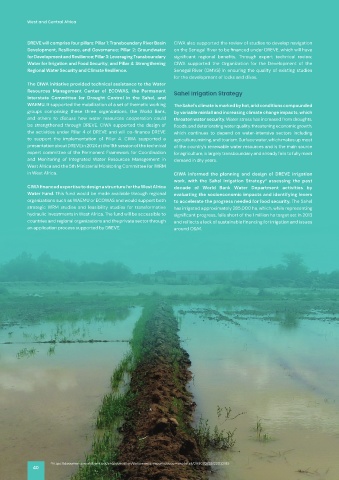
           WAEMU. It supported the mobilization of a set of thematic working   The Sahel’s climate is marked by hot, arid conditions compounded
           groups  comprising  these  three  organizations,  the  World  Bank,   by variable rainfall and increasing climate change impacts, which
           and  others  to  discuss  how  water  resources  cooperation  could   threaten water security. Water stress has increased from droughts,
           be strengthened through DREVE. CIWA supported the design of   floods, and deteriorating water quality, threatening economic growth,


           the activities under Pillar 4 of DREVE and will co-finance DREVE   which  continues  to  depend  on  water-intensive  sectors  including
           to  support  the  implementation  of  Pillar  4.  CIWA  supported  a   agriculture, mining, and tourism. Surface water, which makes up most
           presentation about DREVE in 2024 at the 11th session of the technical   of the country’s renewable water resources and is the main source
           expert committee of the Permanent Framework for Coordination   for agriculture, is largely transboundary and already fails to fully meet
           and  Monitoring  of  Integrated  Water  Resources  Management  in   demand in dry years.
           West Africa and the 5th Ministerial Monitoring Committee for IWRM
           in West Africa.                                    CIWA informed the planning and design of DREVE  irrigation
                                                              work,  with  the  Sahel  Irrigation  Strategy  assessing the past
                                                                                              3

           CIWA financed expertise to design a structure for the West Africa   decade  of  World  Bank  Water  Department  activities  by
           Water Fund. This fund would be made available through regional   evaluating the socioeconomic impacts and identifying levers
           organizations such as WAEMU or ECOWAS and would support both   to accelerate the progress needed for food security. The Sahel
           strategic  WRM  studies  and  feasibility  studies  for  transformative   has irrigated approximately 285,000 ha, which, while representing
           hydraulic investments in West Africa. The fund will be accessible to   significant progress, falls short of the 1 million ha target set in 2013

           countries and regional organizations and the private sector through   and reflects a lack of sustainable financing for irrigation and issues


           an application process supported by DREVE.         around O&M.


                   3  https://documents.worldbank.org/en/publication/documents-reports/documentdetail/099070725122032185
             40

