


Page 45 - CIWA AR25
P. 45
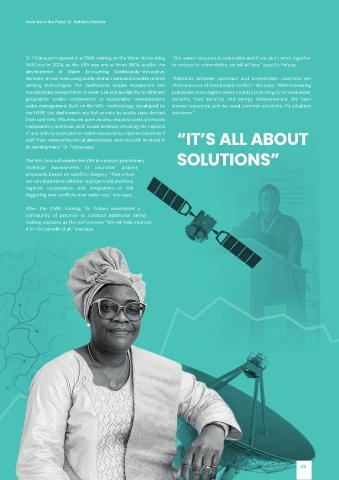
View from the Field: Dr. Rafatou Fofana


          Dr. Fofana participated in a CIWA training on the Water Accounting   “Our water resource is vulnerable and if we don’t work together
          (WA) tool in 2024, as the VBA was one of three RBOs to pilot the   to reduce its vulnerability, we will all lose,” says Dr. Fofana.
          development  of  Water  Accounting  Dashboards—innovative,
          demand-driven tools using public domain data and scalable remote   “Relations  between  upstream  and  downstream  countries  are

          sensing  technologies.  WA  Dashboards  enable  transparent  and   often a source of tension and conflict,” she says. “With increasing
          standardized assessments of water use and availability at different   pressures in our region, every country is striving to achieve water
          geographic  scales—fundamental  to  sustainable  transboundary   security,  food  security,  and  energy  independence.  We  have
          water management. Built on the WA+ methodology developed by   shared resources, and we need common solutions. It’s all about
          the IWMI, the dashboards are fed entirely by public data derived   solutions.”
          from satellites. This ensures open access, reduces costs, promotes
          transparency and trust, and “would facilitate checking the impacts
          of any activity or project on water resources by riparian countries if
          staff from national technical directorates were directly involved in   “IT’S ALL ABOUT
          its development,” Dr. Fofana says.

          The WA+ tool will enable the VBA to conduct preliminary   SOLUTIONS”
          technical  assessments  of  countries’  project
          proposals based on satellite imagery. “That’s how
          we can determine whether a project will promote
          regional  cooperation  and  integration—or  risk

          triggering new conflicts over water use,” she says.
          After  the  CIWA  training,  Dr.  Fofana  assembled  a
          community  of  practice  to  conduct  additional  online
          training sessions as the tool evolves. “We will help improve
          it for the benefit of all,” she says.


                                                                                                           45

