


Page 49 - CIWA AR25
P. 49
Southern Africa


          partnerships with the University of the Free State in South Africa,   to  identify  shared  groundwater  challenges  and  inform  joint
          Mzuzu University in Malawi, University of Botswana, and University   management. Additionally, hydro-census studies in the Songwe
          of  Namibia  to  collect  technical  assessments,  research  papers,   Basin (Malawi and Tanzania) and the Inco-Maputo Basin (Eswatini,
          published conference proceedings, and manuals in groundwater   Mozambique, and South Africa) provided detailed inventories of
          management  and  to  enhance  engagement  with  students  and   groundwater  users  and  infrastructure.  These  tools  have  been
          other stakeholders. The SADC-GLA has experienced consistent   integral in supporting evidence-based groundwater governance
          growth in user engagement, with 10,473 unique visitors and 12,679   and sustainable use across the region.
          total visits recorded between January 2024 and May 2025. This
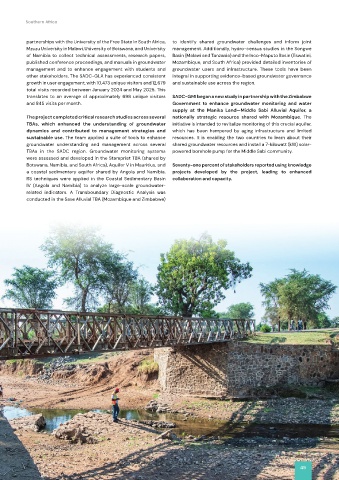
          translates  to  an  average  of  approximately  698  unique  visitors   SADC‑GMI began a new study in partnership with the Zimbabwe
          and 845 visits per month.                           Government  to  enhance  groundwater  monitoring  and  water
                                                              supply  at  the  Manika  Land—Middle  Sabi  Alluvial  Aquifer,  a
          The project completed critical research studies across several   nationally  strategic  resource  shared  with  Mozambique. The
          TBAs,  which  enhanced  the  understanding  of  groundwater   initiative is intended to revitalize monitoring of this crucial aquifer,
          dynamics and contributed to management strategies and   which  has  been  hampered  by  aging  infrastructure  and  limited
          sustainable use. The team applied a suite of tools to enhance   resources.  It  is  enabling  the  two  countries  to  learn  about  their
          groundwater  understanding  and  management  across  several   shared groundwater resources and install a 7-kilowatt (kW) solar-
          TBAs  in  the  SADC  region.  Groundwater  monitoring  systems   powered borehole pump for the Middle Sabi community.
          were assessed and developed in the Stampriet TBA (shared by
          Botswana, Namibia, and South Africa), Aquifer V in Mauritius, and   Seventy‑one percent of stakeholders reported using knowledge
          a  coastal  sedimentary  aquifer  shared  by  Angola  and  Namibia.   projects  developed  by  the  project,  leading  to  enhanced
          RS  techniques  were  applied  in  the  Coastal  Sedimentary  Basin   collaboration and capacity.
          IV  (Angola  and  Namibia)  to  analyze  large-scale  groundwater-
          related  indicators.  A  Transboundary  Diagnostic  Analysis  was
          conducted in the Save Alluvial TBA (Mozambique and Zimbabwe)


                                                                                                          49

