


Page 36 - CIWA AR25
P. 36
View from the Field: Milly Mbuliro


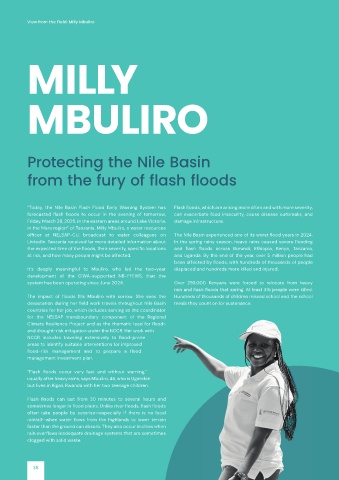
           MILLY


           MBULIRO


           Protecting the Nile Basin


           from the fury of flash floods


           “Today,  the  Nile  Basin  Flash  Flood  Early  Warning  System  has   Flash floods, which are arising more often and with more severity,


           forecasted  flash  floods  to  occur  in  the  evening  of  tomorrow,   can  exacerbate  food  insecurity,  cause  disease  outbreaks,  and
           Friday, March 28, 2025, in the eastern areas around Lake Victoria,   damage infrastructure.
           in the Mara region” of Tanzania, Milly Mbuliro, a water resources
           officer  at  NELSAP-CU,  broadcast  to  water  colleagues  on   The Nile Basin experienced one of its worst flood years in 2024.


           LinkedIn. Tanzania received far more detailed information about   In the spring rainy season, heavy rains caused severe flooding


           the expected time of the floods, their severity, specific locations   and  flash  floods  across  Burundi,  Ethiopia,  Kenya,  Tanzania,
           at risk, and how many people might be affected.    and Uganda. By the end of the year, over 5 million people had
                                                              been affected by floods, with hundreds of thousands of people

           It’s  deeply  meaningful  to  Mbuliro,  who  led  the  two-year   displaced and hundreds more killed and injured.
           development  of  the  CIWA-supported  NB-FFEWS,  that  the
           system has been operating since June 2024.         Over  293,000  Kenyans  were  forced  to  relocate  from  heavy


                                                              rain and flash floods that spring. At least 315 people were killed.


           The  impact  of  floods  fills  Mbuliro  with  sorrow.  She  sees  the   Hundreds of thousands of children missed school and the school

           devastation during her field work travels throughout Nile Basin   meals they count on for sustenance.
           countries for her job, which includes serving as the coordinator
           for  the  NELSAP  transboundary  component  of  the  Regional
           Climate Resilience Project and as the thematic lead for flood-

           and drought-risk mitigation under the NCCR. Her work with
           NCCR  includes  traveling  extensively  to  flood-prone

           areas to identify suitable interventions for improved
           flood-risk  management  and  to  prepare  a  flood


           management investment plan.
           “Flash  floods  occur  very  fast  and  without  warning,”

           usually after heavy rains, says Mbuliro, 45, who is Ugandan
           but lives in Kigali, Rwanda with her two teenage children.
           Flash  floods  can  last  from  30  minutes  to  several  hours  and


           sometimes longer in flood plains. Unlike river floods, flash floods


           often  take  people  by  surprise—especially  if  there  is  no  local
           rainfall—when  water  flows  from  the  highlands  to  lower  terrain

           faster than the ground can absorb. They also occur in cities when
           rain overflows inadequate drainage systems that are sometimes

           clogged with solid waste.
             36

