


Page 35 - CIWA AR25
P. 35
East Africa


          NEXT STEPS

          The project was launched in April 2025 and is currently under   The initiative will unfold in two main phases: a Design Phase, which
          implementation.  The  NBD  Secretariat  is  scaling  up  technical   includes stakeholder consultations, reconnaissance visits, and
          experts  and  consultants,  identifying  key  stakeholders,  engaging   development  of  a  comprehensive  technical  framework,  and
          local communities in the target areas in the basin, and establishing   an  Implementation  Phase,  focused  on  rolling  out  tools,  data
          partnerships  with  the  Nile  Media  Network  and  strategic   collection, quality assurance, training, and maintenance of the
          relationships between the NDFs, Ministries, and the Media Network.     citizen data system.  Pilot  sites  include  the  Sio-Siteko  Wetland
                                                             (Kenya-Uganda)  and  the  Mara  Wetlands  (Tanzania-Kenya),  both

          NBD  is  procuring  a  firm  to  lead  citizen  data  science  actions   facing  acute  environmental  pressures  from  pollution  and  land-

          in the first phase of its Citizen Data Initiative, a core element   use  change.  Based  on  lessons  learned,  the  model  will  be  scaled
          of its broader strategy to support community-led data   up  to  the  Kagera  River  Basin—one  of  the  most  ecologically  and
          collection and management.  This  initiative,  launched  under   socioeconomically  critical  sub-basins  feeding  Lake  Victoria.
          Subcomponent  1A  of  the  project,  is  designed  to  empower  local   This  phase-wise  approach  aims  to  build  a  replicable  model  that
          communities to generate reliable data on water quality, land and   promotes  transparency,  strengthens  governance,  and  enables
          wetland degradation, and climate-related hazards. The rationale   informed, citizen-driven climate resilience across the Nile Basin.
          is to improve decision making, disaster response, and sustainable
          water management while strengthening citizen engagement and   The  next  steps  under  Component  2  of  the  project  focus  on
          integrating indigenous knowledge into environmental governance.   advancing women’s empowerment and youth engagement in Nile
          Leveraging its grassroots network, NBD holds a unique advantage   Basin cooperation. A  regional  workshop  will  be  convened  for  the
          in mobilizing communities to cost-effectively gather actionable,   Nile Women’s Network to review progress, share best practices in
          on-the-ground data that governments and research institutions   networking, and develop strategies for long-term sustainability and
          often struggle to obtain at scale.                 strategic partnerships that amplify women’s voices in transboundary
                                                             water  governance.  Simultaneously,  the  internship  program  will  be
                                                             activated through the recruitment of 10 interns placed within their
                                                             respective NDFs, alongside a Young Professional, who will be stationed
                                                             at the NBD Secretariat in Entebbe, supporting capacity-building and
                                                             strengthening youth participation in regional water dialogue.


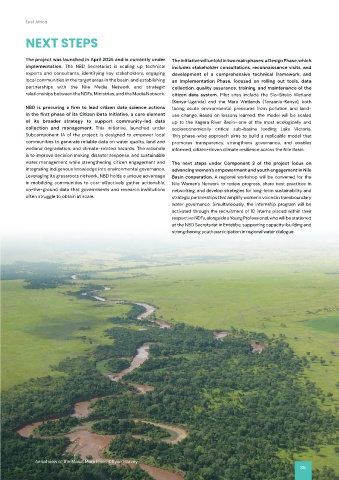
              Aerial view of the Masai Mara River. ©Ryan Harvey
                                                                                                          35

