


Page 23 - CIWA AR25
P. 23
Horn of Africa


          climate risk management into development planning, early-warning   RCRP  established  a  strong  foundation  for  collaboration  and
          and  hazard  monitoring,  and  risk  mitigation  measures  for  water   knowledge  exchange  among  client  countries  (Comoros,
          supply and critical infrastructure.                Madagascar, Mozambique, and South Sudan) and regional
                                                             institutions.  In  June  2025,  the  South  Sudan  delegation  joined
          The program aims to strengthen institutions supporting the   all  RCRP  countries  in  Mozambique  for  a  regional  workshop.
          capacity  of  government  agencies  to  manage  climate  risks,   Sessions  focused  on  leveraging  lessons  learned  to  inform  the
          drawing on global best practices to inform recommendations   future design, programming, and maintenance of infrastructure,
          for  integrating  climate  risk  management  into  South  Sudan’s   with  technical  discussions  covering  resilient  water  resources
          refugee policies and frameworks. Information was disseminated   management,  climate  variability,  maintenance  challenges,  and
          to key stakeholders, a stakeholder mapping was completed, and   gender inclusion.
          data collection started.
                                                             PILLAR 3:
          PILLAR 2:
                                                             Knowledge Generation and Capacity-Building
          Strengthening Regional Information Exchange
                                                             This pillar aims to strengthen core sector capacity and knowledge,
          This pillar supports the development of protocols for information   with a focus on biodiversity and FCV.
          exchange between South Sudan and the NBI and exchange and
          policy dialogue with neighboring riparian countries.  In  FY25,  a  key  activity  was  strengthening  capacity‑building
                                                             for  future  transboundary  water  engagement  and  investment
          A major focus in FY25 was on building the capacities of South   prioritization, with a focus on biodiversity and FCV contexts to
          Sudan’s  Ministry of  Water Resources  and Irrigation (MWRI),   enhance decision making. The program is conducting a strategic

          Eastern Nile Technical Regional Office (ENTRO), and Nile Equatorial   study  on  the  hydrological  services  provided  by  South  Sudan’s
          Lakes  Subsidiary  Action  Program  Coordination  Unit  (NELSAP‑  ecosystems, especially the Sudd wetland. This study, currently at its
          CU) in the development of multi‑hazard early‑warning systems   inception stage, aims to benefit all Nile riparian states by providing a

          and  services.  The  emphasis  is  on  enhancing  the  early-warning   detailed understanding of how South Sudan’s ecosystems influence

          system through improved observation, monitoring, and forecasting   the  basin’s  hydrological  balance.  The  CIWA  FCV  Framework  and
          capabilities, and strengthening early-warning communication and   Biodiversity Framework are informing the study.
          dissemination.  This  includes  the  regular  distribution  of  weekly

          Earth  Observation.  maps  to  support  flood  tracking  and  decision
          making.  A  second  Real-Time  Flood  Monitoring  Data  workshop
          was  held,  bringing  together  the  MWRI,  ENTRO,  and  NELSAP-CU
          virtually to strengthen their shared understanding of data sources

          and methodologies used in flood monitoring and forecasting. The
          workshop  also  focused  on  building  technical  capacity  for  the
          development  of  multi-hazard  early-warning  systems,  which  are
          critical for timely and effective disaster response.


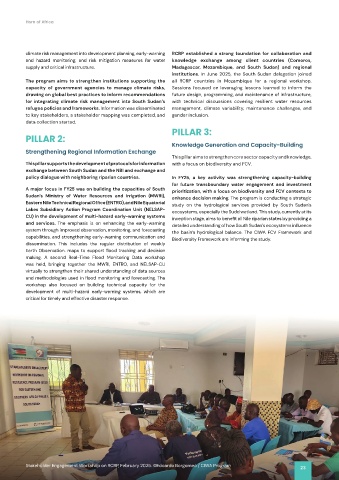
          Stakeholder Engagement Workshop on RCRP, February 2025. ©Edoardo Borgomeo / CIWA Program
                                                                                                          23

