


Page 29 - CIWA AR25
P. 29
East Africa


          NILE COOPERATION FOR


          CLIMATE RESILIENCE


          CONTEXT                                             PROGRESS


          Effective  and  cooperative  management  of  the  Nile  River   Platform for cooperation:
          Basin’s transboundary water resources is essential not only for

          fostering prosperity but also for minimizing the risk of conflict.   In FY25, the Nile‑SEC updated its Communication and Stakeholder
          The countries along the Nile River are united by a shared goal of   Engagement  Strategy,  and  a  Regional  Communications  and
          achieving sustainable socioeconomic development, a pursuit that   Stakeholder Engagement Specialist is now on board. An experiential
          inherently  requires  collaborative  action.  The  Nile  Basin,  which   tour  to  the  Zambezi  Watercourse  Commission  (ZAMCOM)  of  the

          spans 11 countries, presents each nation with distinct challenges,   Permanent  Secretaries  for  water,  finance,  and  foreign  affairs  from
          yet all are committed to ambitious national development agendas   Member States was conducted in July 2024. The annual Nile Day
          that rely heavily on the responsible and sustainable use of shared   took place in Addis Ababa on February 22, 2025, and was preceded
          water  resources.  By  approaching  development  from  a  regional   by  a  Nile  Council  of  Ministers  meeting  and  development  partner
          perspective,  these  countries  can  amplify  the  benefits  and   roundtable, with the full participation of Basin countries.

          sustainability of their investments, unlocking the full productive


          potential of the basin through joint action and mutual support.  The  NELSAP‑CU  finalized  technical  reports  on  floods  and
                                                              droughts,  dam  safety,  and  water  quality;  produced  various
          The  Nile  Cooperation  for  Climate  Resilience  (NCCR)  project,   communication products including a ‘how to’ video for FFEWS,
          which began in March 2021, is funded by a US$30 million CIWA   newsletters, and   Project Briefs on Dam Inventory and Risk
          grant and is scheduled to close in November 2025, with a strong   Framework;  and  updated  Project  Briefs  on  water  quality


          emphasis on ensuring the sustainability and continued use of project   and flash floods. Six  country  benefit  booklets  describing  how
          outputs beyond its closure. By offering a platform for cooperation   countries gain from working with the NBI and regional cooperation
          among communities, policymakers, and water managers, the NCCR   in general have been completed and published. Environment and
          project  supports  the  sustainable  and  equitable  management  of   science journalists from Nile Basin countries were trained and
          the Nile Basin’s water resources, ultimately contributing to climate   continue to be ambassadors in telling the stories that promote
          resilience  and  long-term  regional  development.  Through  the   climate resilience and investment planning.
          coordinated efforts of the three NBI centers—the ENTRO, NELSAP-
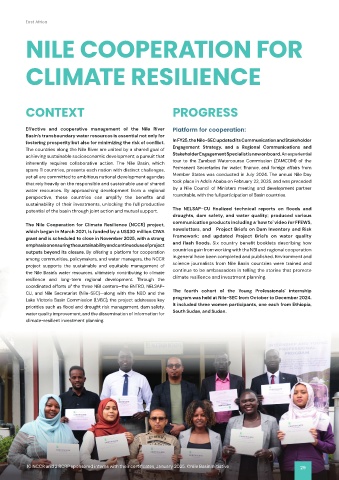
          CU,  and  Nile  Secretariat  (Nile-SEC)—along  with  the  NBD  and  the   The  fourth  cohort  of  the  Young  Professionals’  internship
          Lake Victoria Basin Commission (LVBC), the project addresses key   program was held at Nile‑SEC from October to December 2024.

          priorities such as flood and drought risk management, dam safety,   It included three women participants, one each from Ethiopia,
          water quality improvement, and the dissemination of information for   South Sudan, and Sudan.
          climate-resilient investment planning.


           10 NCCR and 2 RCRP sponsored interns with their certificates, January 2025. ©Nile Basin Initiative

                                                                                                          29

