


Page 111 - CIWA AR25
P. 111
Annexes


          CIWA  achieves  lower  costs  by  basing  budgets  for  projects  on   additional  sources  of  funding  for  RETF  projects,   thereby
                                                                                                       14
          a careful assessment of estimated costs and through effective   reducing its unit cost of inputs in relation to the overall sum
          procurement  processes,  cost-sharing,  and  greater  travel   of outputs it mobilizes. CIWA uses the following metric as an

          efficiencies, using video connection for meetings when possible,   indicator of increased economy due to leveraging of funds
          convening  CIWA  meetings  back-to-back  when  feasible,  and   from additional sources:
          linking to other water sector-related meetings to take advantage
          of  synergies.  Within  the  overall  6  percent   range,  the  program    Σ Funds leveraged from additional sources for CIWA projects
          manager has the discretion to allocate additional preparation or   Leverage ratio =

          supervision funds to individual projects based on need.              Σ CIWA contributions to cofinanced projects

          Effi ciency
          •   Leverage  Ratio—CIWA  improves  its  economy  by  leveraging

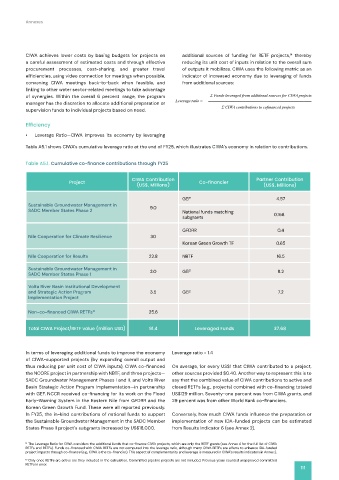
          Table A5.1 shows CIWA’s cumulative leverage ratio at the end of FY25, which illustrates CIWA’s economy in relation to contributions.


          Table A5.1. Cumulative co-fi nance contributions through FY25

                                               CIWA Contribution                           Partner Contribution
                         Project                                       Co-fi nancier
                                                 (US$, Millions)                              (US$, Millions)
                                                                 GEF                              4.57
           Sustainable Groundwater Management in      9.0
           SADC Member States Phase 2                            National funds matching
                                                                 subgrants                       0.158

                                                                 GFDRR                            0.4
           Nile Cooperation for Climate Resilience    30
                                                                 Korean Green Growth TF           0.65


           Nile Cooperation for Results              22.8        NBTF                             16.5
           Sustainable Groundwater Management in      2.0        GEF                               8.2
           SADC Member States Phase 1
           Volta River Basin Institutional Development
           and Strategic Action Program               3.5        GEF                               7.2
           Implementation Project


           Non-co-financed CIWA RETFs 15              25.6

           Total CIWA Project/RETF value (million USD)  91.4         Leveraged Funds             37.68


          In terms of leveraging additional funds to improve the economy   Leverage ratio = 1.4
          of  CIWA-supported  projects  (by  expanding  overall  output  and

          thus reducing per unit cost of CIWA inputs), CIWA co-financed   On average, for every US$1 that CIWA contributed to a project,
          the NCORE project in partnership with NBTF, and three projects—  other sources provided $0.40. Another way to represent this is to
          SADC Groundwater Management Phases I and II, and Volta River   say that the combined value of CIWA contributions to active and
          Basin Strategic Action Program Implementation—in partnership   closed RETFs (e.g., projects) combined with co-financing totaled

          with GEF. NCCR received co-financing for its work on the Flood   US$129 million. Seventy-one percent was from CIWA grants, and

          Early-Warning System in the Eastern Nile from GFDRR and the   29 percent was from other World Bank co-financiers.

          Korean Green Growth Fund. These were all reported previously.
          In FY25, the in-kind contributions of national funds to support   Conversely, how much CIWA funds influence the preparation or

          the Sustainable Groundwater Management in the SADC Member   implementation  of  new  IDA-funded  projects  can  be  estimated
          States Phase II project’s subgrants increased by US$18,000.    from Results Indicator 6 (see Annex 2).

          14  The Leverage Ratio for CIWA considers the additional funds that co-fi nance CIWA projects, which are only the RETF grants (see Annex 4 for the full list of CIWA
          RETFs and BETFs). Funds co-financed with CIWA BETFs are not computed into the leverage ratio, although many CIWA BETFs are efforts to enhance IDA-funded

          project impacts through co-finance (e.g., CIWA is the co-financier). This aspect of complementarity and leverage is measured in CIWA’s results indicators in Annex 2.


          15  Only once RETFs are active are they included in the calculation. Committed pipeline projects are not included. Previous years counted unapproved committed
          RETFs in error.
                                                                                                           111

