


Page 112 - CIWA AR25
P. 112
Annexes


           Effectiveness / Cost Effectiveness                 Investment‑influenced ratio:
           CIWA  measures  its  effectiveness,  e.g.,  its  ability  to  achieve  its   Total investment value = US$17.4 billion
           intended program development outcomes relative to its targets,   Funds committed = US$163.1million
           through  the  program  Indicator  Results  (Annex  2).  Since  CIWA
           adjusted the formulation of its Results Framework, annual targets   On average, for every US$1 contributed by CIWA to operations

           are  now  set  and  indicator  results  reported  for  the  respective   (funds  committed),  the  program  influenced  US$106.7  in

           fiscal year rather than cumulatively. CIWA began tracking results   cooperative investment value. In FY25, the total investment value
           against the new annual targets in FY25.            increased by only ~US$100,000 but committed funds increased
                                                              by US$28.2 million.
           PDO  Indicator  1:  US$30-40  million  influenced  investments  are


           mobilized.                                         Direct beneficiaries ratio:
                                                                Total beneficiaries = 86.3 million

           PDO  Indicator  2:    300,000  people  will  directly  benefit  from   Funds committed = US$163.4 million

           improved  water  resources  management  and  development

           projects influenced by CIWA.
                                                              For every US$2.1 committed by CIWA, approximately one person
                                                              will  benefit,  or  has  directly  benefited,  from  transboundary


           In FY25, the Nsongezi Hydropower Project, supported by the NBI   water  resources  potential  or  mobilized  investments.  This  also
           and NCORE, was moved from potential to mobilized investments.   increased from FY24, since the total beneficiaries increased by ~

           The Nsongezi Hydropower Project is primarily located in Uganda,   12 percent, but funds committed increased by 17.5 percent.
           but  it  is  situated  on  the Kagera  River,  which  forms  the  border
           between Uganda and Tanzania. This is valued at US$156 million   Overall,  the  effectiveness  calculation  indicates  a  decrease
           and  will  benefit  a  population  of  over  4  million  people.  Other   from previous years despite mobilizing a significant investment


           changes include increased mobilized investments in the SADC   from  NCORE.  The  reason  is  due  to  the  significant  increase  in

           GMI  Phase  II  project  Subgrants.  Quantitatively,  the  target  has   committed  funds  and  that  mobilizing  a  potential  investment
           been  exceeded  but  not  through  the  expected  investment,   does not change the total investment value.
           whereas  the  value  of  potential  investments  decreased  by  the
           same amount and the total remained at US$17.4 billion.
                                                              Commercial Improvement and Value for Money
           The indicators found in CIWA’s Results Framework, however, do not   CIWA  maintains  economy  in  its  procurement  (minimizing  costs

           fully capture secondary and tertiary benefits of CIWA support. A   and ensuring high quality) by requiring that all recipient-executed

           transboundary  institution  strengthened  by  CIWA,  for  example,   activities finance goods, works, and services in accordance with
           can facilitate a series of subsequent regional cooperative actions.   the World Bank’s guidelines on “Procurement under IBRD Loans and
           Millions  of  people  receive  various  levels  of  benefits  as  a  result   IDA Credits” and its guidelines on the “Selection and Employment

           of  each  cooperative  action  facilitated  by  the  strengthened   of  Consultants  by  World  Bank  Borrowers,”  jointly  referred  to  as
           transboundary institution. These outputs are often counted and   the  “Procurement  and  Consultant  Guidelines.”    Similarly,  for  all
           reported on at the basin and project level but are too broad and   World  Bank-executed  CIWA  activities,  the  Bank  is  responsible
           distinct  to  aggregate  at  the  program  level,  given  the  nature  of   for  carrying  out  procurement  of  goods  and  employment  and

           issues  supported  and  the  timeframe  it  takes  for  such  benefits   supervision of consultants, in accordance with applicable policies
           to manifest. In the long run, therefore, CIWA’s actual efficiency is   and  procedures.  Among  other  things,  the  guidelines  provide


           likely to be underestimated by the Results Framework.    specific  instructions  for  use  of  World  Bank  documents  (e.g.,
                                                              standard  bidding  documents,  requests  for  proposals,  contract


           CIWA  estimates  the  cost  effectiveness  of  the  program  by   forms),  conflicts  of  interest,  advance  contracting,  co-financing,
           calculating the ratio of the two PDO level outcomes to the value   mis-procurement, and fraud and corruption.
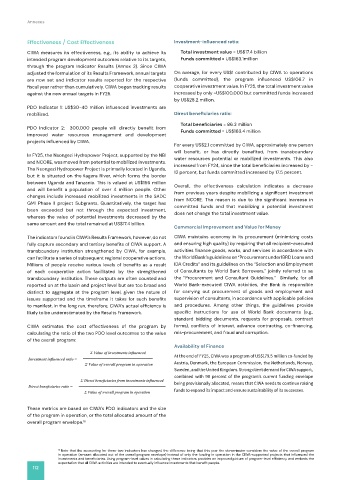
           of the overall program:
                                                              Availability of Finance
                                 Σ Value of investments influenced  At the end of FY25, CIWA was a program of US$179.5 million co-funded by


           Investment influenced ratio =
                               Σ Value of overall program in operation  Austria, Denmark, the European Commission, the Netherlands, Norway,
                                                              Sweden, and the United Kingdom. Strong client demand for CIWA support,
                                                              combined with 98 percent of the program’s current funding envelope


                             Σ Direct beneficiaries from investments influenced  being provisionally allocated, means that CIWA needs to continue raising

           Direct beneficiaries ratio =
                               Σ Value of overall program in operation  funds to expand its impact and ensure sustainability of its successes.
           These metrics are based on CIWA’s PDO indicators and the size
           of the program in operation, or the total allocated amount of the
           overall program envelope. 16


                      16  Note that the accounting for these two indicators has changed, the difference being that this year the denominator considers the value of the overall program
                      in operation (amount allocated out of the overall program envelope) instead of only the funding in operation in the CIWA-supported projects that influenced the


                      investments and beneficiaries. Using program-level values in calculating these indicators provides an improved picture of program-level efficiency and embeds the


                      expectation that all CIWA activities are intended to eventually influence investments that benefit people.
             112

