


Page 70 - CIWA AR25
P. 70
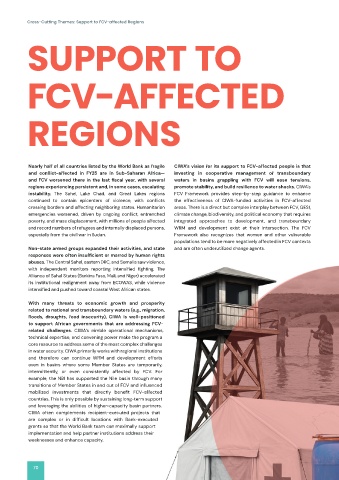
Cross-Cutting Themes: Support to FCV-affected Regions


           SUPPORT TO


           FCV-AFFECTED


           REGIONS


           Nearly half of all countries listed by the World Bank as fragile   CIWA’s vision for its support to FCV‑affected people is that

           and  conflict‑affected  in  FY25  are  in  Sub‑Saharan  Africa—  investing  in  cooperative  management  of  transboundary

           and  FCV  worsened  there  in  the  last  fiscal  year,  with  several   waters  in  basins  grappling  with  FCV  will  ease  tensions,
           regions experiencing persistent and, in some cases, escalating   promote stability, and build resilience to water shocks. CIWA’s
           instability.  The  Sahel,  Lake  Chad,  and  Great  Lakes  regions   FCV  Framework  provides  step-by-step  guidance  to  enhance

           continued  to  contain  epicenters  of  violence,  with  conflicts   the  effectiveness  of  CIWA-funded  activities  in  FCV-affected
           crossing borders and affecting neighboring states. Humanitarian   areas. There is a direct but complex interplay between FCV, GESI,
           emergencies  worsened,  driven  by  ongoing  conflict,  entrenched   climate change, biodiversity, and political economy that requires

           poverty, and mass displacement, with millions of people affected   integrated  approaches  to  development,  and  transboundary
           and record numbers of refugees and internally displaced persons,   WRM  and  development  exist  at  their  intersection.  The  FCV
           especially from the civil war in Sudan.            Framework  also  recognizes  that  women  and  other  vulnerable
                                                              populations tend to be more negatively affected in FCV contexts
           Non‑state armed groups expanded their activities, and state   and are often underutilized change agents.
           responses were often insufficient or marred by human rights

           abuses. The Central Sahel, eastern DRC, and Somalia saw violence,


           with  independent  monitors  reporting  intensified  fighting.  The
           Alliance of Sahel States (Burkina Faso, Mali, and Niger) accelerated
           its  institutional  realignment  away  from  ECOWAS,  while  violence
           intensified and pushed toward coastal West African states.

           With  many  threats  to  economic  growth  and  prosperity
           related to national and transboundary waters (e.g., migration,

           floods,  droughts,  food  insecurity),  CIWA  is  well‑positioned
           to  support  African  governments  that  are  addressing  FCV‑
           related challenges.  CIWA’s  nimble  operational  mechanisms,
           technical expertise, and convening power make the program a
           core resource to address some of the most complex challenges
           in water security. CIWA primarily works with regional institutions
           and  therefore  can  continue  WRM  and  development  efforts
           even  in  basins  where  some  Member  States  are  temporarily,
           intermittently,  or  even  consistently  affected  by  FCV.  For
           example, the NBI has supported the Nile basin through many

           transitions of Member States in and out of FCV and influenced

           mobilized  investments  that  directly  benefit  FCV-affected
           countries. This is only possible by sustaining long-term support
           and leveraging the abilities of higher-capacity basin partners.
           CIWA  often  complements  recipient-executed  projects  that
           are  complex  or  in  difficult  locations  with  Bank-executed

           grants so that the World Bank team can maximally support
           implementation and help partner institutions address their
           weaknesses and enhance capacity.


             70

