


Page 68 - CIWA AR25
P. 68
View from the Field: Pinimidzai Sithole


          PINIMIDZAI


          SITHOLE


           A Male Champion who preaches


           and practices gender equality


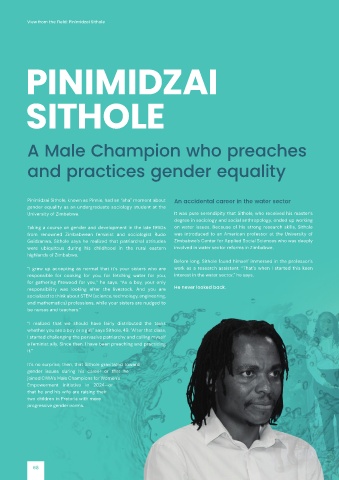
           Pinimidzai Sithole, known as Pinnie, had an “aha” moment about   An accidental career in the water sector
           gender equality as an undergraduate sociology student at the
           University of Zimbabwe.                            It was pure serendipity that Sithole, who received his master’s
                                                              degree in sociology and social anthropology, ended up working
           Taking a course on gender and development in the late 1990s   on  water  issues.  Because  of  his  strong  research  skills,  Sithole
           from  renowned  Zimbabwean  feminist  and  sociologist  Rudo   was  introduced  to  an  American  professor  at  the  University  of
           Gaidzanwa,  Sithole  says  he  realized  that  patriarchal  attitudes   Zimbabwe’s Center for Applied Social Sciences who was deeply
           were  ubiquitous  during  his  childhood  in  the  rural  eastern   involved in water sector reforms in Zimbabwe.
           highlands of Zimbabwe.
                                                              Before long, Sithole found himself immersed in the professor’s
           “I  grew  up  accepting  as  normal  that  it’s  your  sisters  who  are   work  as  a  research  assistant.  “That’s  when  I  started  this  keen
           responsible  for  cooking  for  you,  for  fetching  water  for  you,   interest in the water sector,” he says.

           for  gathering  firewood  for  you,”  he  says.  “As  a  boy,  your  only
           responsibility  was  looking  after  the  livestock.  And  you  are   He never looked back.
           socialized to think about STEM (science, technology, engineering,
           and mathematics) professions, while your sisters are nudged to
           be nurses and teachers.”

           “I  realized  that  we  should  have  fairly  distributed  the  tasks
           whether you are a boy or a girl,” says Sithole, 49. “After that class,
           I started challenging the pervasive patriarchy and calling myself
           a feminist ally. Since then, I have been preaching and practicing
           it.”

           It’s no surprise, then, that Sithole gravitated toward
           gender  issues  during  his  career  or  that  he
           joined CIWA’s Male Champions for Women’s
           Empowerment  initiative  in  2024—or
           that he and his wife are raising their
           two children in Pretoria with more
           progressive gender norms.


             68

